Hernando County's Data Center Moratorium, Explained: What It Means for Your Bills, Your Water, and Your Neighborhood
By Hernando Beacon · June 10, 2026 · 4 min read
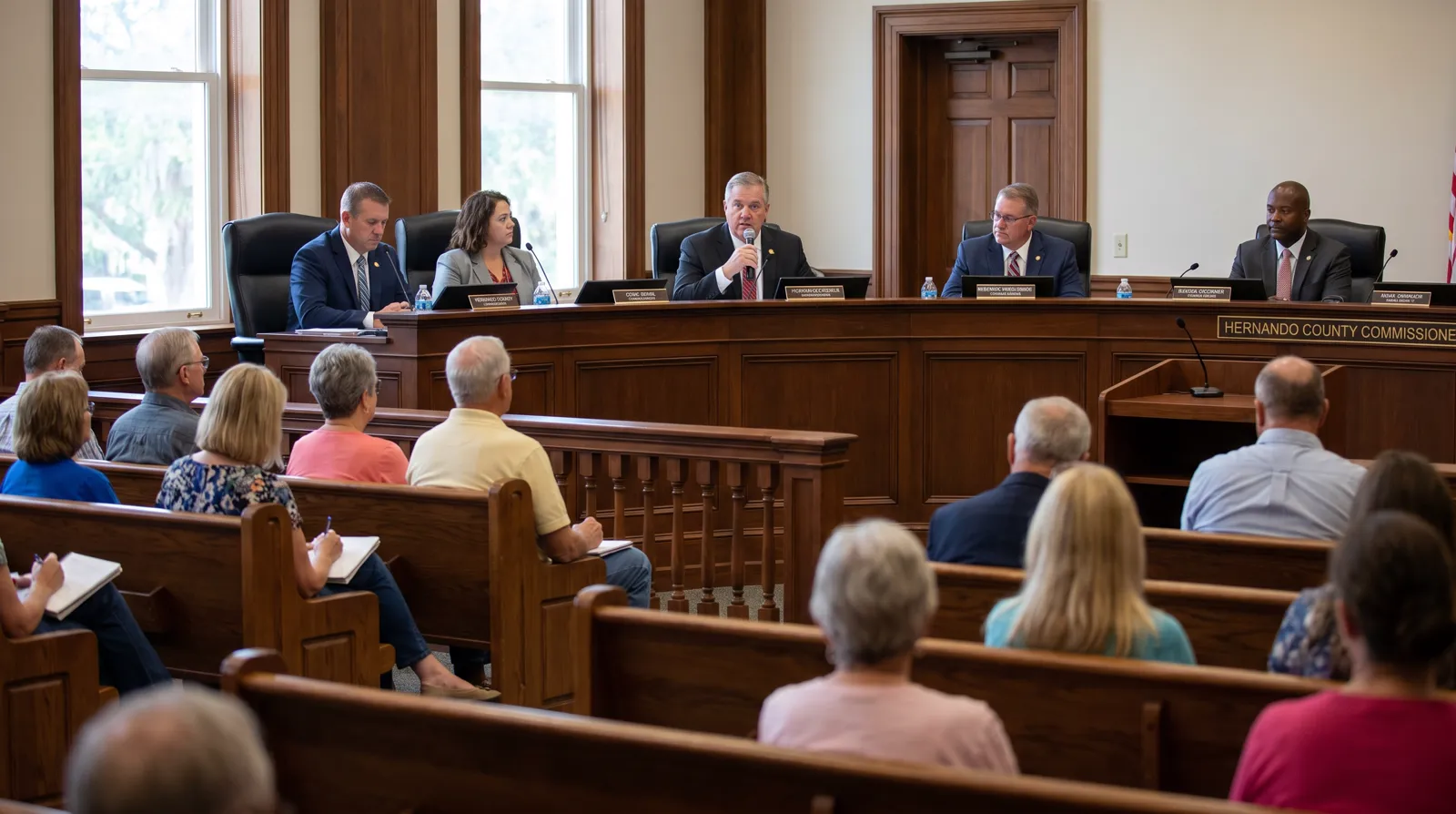
If you’ve seen “data center moratorium” in your feed this week and weren’t sure whether it meant your power bill is about to spike or a warehouse full of servers is going up next to your subdivision, here’s the plain version. On a unanimous vote, the Hernando County Board of County Commissioners moved to put a one-year pause on data center permits across unincorporated Hernando County. The first reading happened in early June, and the final adoption vote is set for July 7, 2026. Nothing about your water or electric bill changes today. What changed is that the county slammed the brakes before a single large server farm could get a permit under rules that, frankly, were never written to handle them.
Commissioner John Allocco championed the pause. Commissioner Brian Hawkins put the county’s position about as bluntly as it gets: “We do not want large-scale data centers in Hernando County.” That’s not a fringe view on the dais — it was unanimous.
What “unincorporated Hernando County” actually means
This is the part that’s easy to miss, and it matters. The moratorium covers unincorporated Hernando County — every part of the county that isn’t inside an incorporated city. That’s the overwhelming majority of where you live: Spring Hill, Weeki Wachee, Hernando Beach, Ridge Manor, the SR-50 and US-98 corridors, the rural stretches out past Brooksville.
The city of Brooksville is the exception. Brooksville runs its own zoning jurisdiction, so the county’s pause does not automatically apply inside city limits. If a data center were ever proposed for a parcel inside the city of Brooksville, that’s a Brooksville decision, not a BOCC one. For the vast majority of Hernando residents, though, the county vote is the one that governs the land near you.
Does this touch my water or electric bill?
Short answer: no, not right now. There is no data center operating in Hernando County drawing down the aquifer or pulling load off the grid, so there’s nothing here moving your monthly bill in either direction.
The longer answer is where the state comes in. Florida SB 484, signed by Governor Ron DeSantis on May 7 and effective July 1, 2026, is the backstop. Two things it does that matter to homeowners:
- It prohibits utilities from passing data-center electricity costs onto residential and small-business ratepayers. In other words, if a data center ever does get built, you’re not subsidizing its enormous power draw on your bill.
- It gives counties clear local zoning authority to regulate these facilities — the legal footing the BOCC needed to act with confidence.
So the moratorium and SB 484 work together: the county buys time to write real rules, and the state law makes sure the energy tab can’t land on you in the meantime.
Why residents pushed back in the first place
Data centers are not quiet, light-footprint neighbors. The concerns raised at the public hearing track what communities across the country have run into:
- Water use — server cooling can consume large volumes, a real issue in a county built on springs and an aquifer.
- Electricity demand — a single facility can pull more power than a small town.
- Noise — cooling systems run around the clock.
- Traffic and wastewater during and after construction.
The sharpest issue is that Hernando’s land-use code was never written with data centers in mind. There were simply no rules on the books governing their water, wastewater, noise, or power-load impacts. The pause exists to fix that gap before a developer exploits it. One resident, Tonie Toney, went further at the hearing and called for a permanent moratorium — a sign of how strong local feeling runs.
The fine print: extensions, exemptions, and what comes next
A few details worth knowing:
- How long it lasts: 365 days — but it’s extendable by up to 120 additional days, meaning the pause could run as long as 485 days total if commissioners need more time to draft regulations.
- The hardship exemption: a developer or landowner isn’t fully locked out. They can petition the county for an exception, with a filing fee of $500. That’s the legal pressure valve — but it’s a petition, not a guarantee.
- What happens after: the moratorium isn’t necessarily a permanent ban. The intent is to use the year to write proper land-use rules. When the pause lifts, data centers could be allowed back — but under standards for water, power, and noise that don’t exist today.
Hernando isn’t acting alone, either. Nassau County, up near Jacksonville, approved its own 12-month data center moratorium on June 9, 2026. This is becoming a statewide pattern as Florida counties digest their new authority under SB 484.
What to do if you care about the outcome
The decision isn’t fully final. The adoption vote is July 7, 2026 at the BOCC — a public meeting, which means residents can show up and speak. If you have an opinion on whether Hernando stays data-center-free, or on what the eventual rules should require for water and power, that meeting is the room where it counts.
Check the county’s published BOCC agenda before July 7 to confirm the meeting time, and bring your three minutes.