The Tampa Bay Metro Is the 8th-Deadliest in America for Pedestrians — and Hernando County Is Inside the Map
By Hernando Beacon · June 13, 2026 · 8 min read
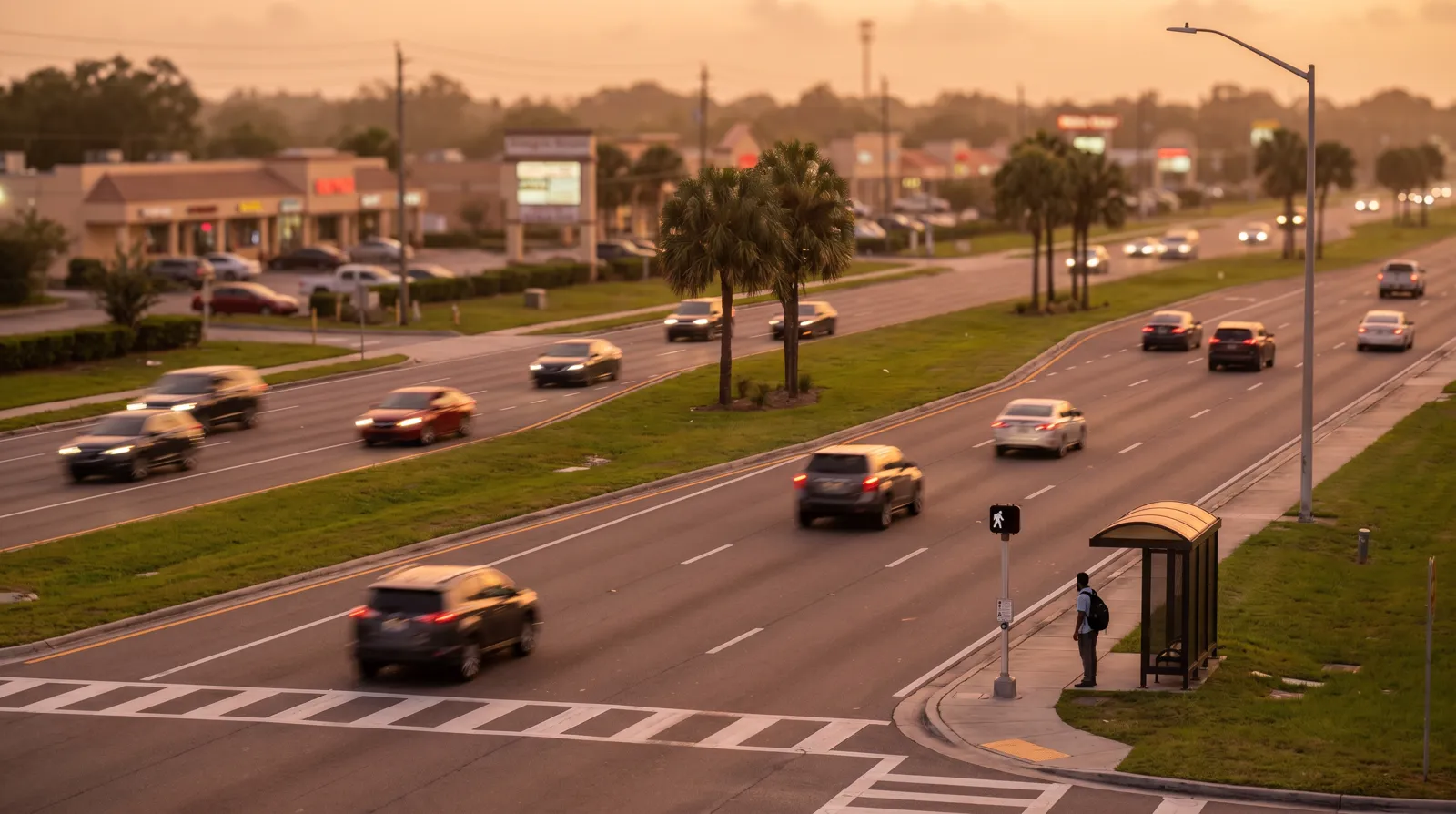
A new national study just put a number on something a lot of people in Spring Hill and Brooksville already feel in their gut every time they try to cross US-19 on foot: this is one of the most dangerous places in the country to be a pedestrian. Dangerous by Design 2026, released this month by the nonprofit Smart Growth America and its National Complete Streets Coalition, ranks the Tampa–St. Petersburg–Clearwater metro the 8th-most-dangerous large metro in America for people on foot — the deadliest in Florida.
Here’s the part that doesn’t make the Tampa headlines: Hernando County is inside that metro. The Tampa–St. Petersburg–Clearwater statistical area covers Hillsborough, Pinellas, Pasco, and Hernando counties. When the study says the Tampa Bay region ranks 8th in the nation, it is counting the deaths on Cortez Boulevard, on Commercial Way, and on Spring Hill Drive right alongside the ones in St. Pete and Tampa. The ranking is ours too.
This is the practical, local version of that study — what the numbers actually are, which Hernando corridors earn the most caution, what FDOT and the county are building to fix it, and the short list of habits that keep you and the people you love off the wrong side of these statistics.
What the Study Found
Dangerous by Design is the longest-running national report card on pedestrian safety; this is the edition built on the most recent federal fatality data, covering 2020 through 2024. The big national finding is grim: pedestrian deaths in the U.S. rose 72% between 2009 and 2024, far outpacing both population growth and the number of miles people drive. We are not walking more — we are dying more while doing it.
Florida sits near the top of nearly every list in the report:
- Florida ranks as the 5th-most-dangerous state in the country for pedestrians.
- Nine of the 27 deadliest metro areas in the nation are in Florida — more than any other state.
- 3,726 people were killed walking in Florida between 2020 and 2024 — the third-highest total of any state, behind only California (5,546) and Texas (3,865).
And the Tampa Bay metros, all of which touch our corner of the Nature Coast region or sit just down the road:
- #8 in the nation — Tampa–St. Petersburg–Clearwater (this includes Hernando County)
- #15 — North Port–Bradenton–Sarasota
- #21 — Lakeland–Winter Haven
For scale: the single deadliest metro in the country, Memphis, came in at a fatality rate of 5.5 deaths per 100,000 residents — the worst the report has recorded since it began in 2009. Tampa Bay’s ranking puts it firmly in that same conversation.
The study also flags two patterns that matter directly for Hernando. First, people ages 50 to 64 make up the single largest group of victims — a sobering detail in a county whose median age runs well above the state average. Second, more than half of all pedestrian deaths happen on state-owned roads — the wide, fast, high-speed arterials. In Hernando, those are exactly the roads people have no choice but to cross.
Why Hernando’s Roads Are Built This Way
The report’s title is the thesis: these roads are dangerous by design. They were engineered decades ago to move cars quickly, not to move people safely on foot. Wide lanes, long sightlines, and half-mile gaps between signals all tell a driver, without a word, that it’s fine to go fast. Then a person tries to cross to a bus stop or a strip-mall on the other side, and the geometry that makes the road efficient for cars makes it lethal for them.
Heidi Simon of Smart Growth America put the fix plainly: “We need to put in more frequent stoppings and crosswalks so that they are unable to get up to high speeds between them.” The problem isn’t reckless individuals. It’s the road itself, doing precisely what it was drawn to do.
Spring Hill is a textbook case. It was platted as a sprawling car-dependent subdivision, then it filled in — but the sidewalks, lighting, and crossings never fully caught up to the people now living and walking there.
The Hernando Corridors to Respect
If you live here, you already know which roads demand your full attention. The study’s data lines up with the local reality. A few corridors stand out — for drivers and walkers alike.
US-19 / Commercial Way. This is the spine of western Hernando, and it is a true high-speed arterial — exactly the “state-owned road” the study warns about. It runs fast, the crossings are far apart, and the consequences are real. In March 2026, a 75-year-old Spring Hill man was killed trying to cross US-19 just south of Long Lake Avenue, struck by multiple vehicles in the early-morning dark. That single crash captures almost every risk factor in the national report at once: an older pedestrian, a wide state road, a long stretch between safe crossings, and low light.
Cortez Boulevard / SR-50. The main east–west route through Brooksville and on toward the coast, Cortez is a multi-lane state road carrying heavy turning volumes and faster speeds. It has seen repeated pedestrian fatalities at and between its intersections, including fatal crashes near the Steuben Street and Commercial Way areas. Long crossing distances and fast through-traffic are a dangerous pairing here.
Spring Hill Drive. A busy commercial corridor with constant driveway turn-ins, strip-mall traffic, and pedestrians moving between shops and bus stops. Its intersection with Mariner Boulevard is among the most crash-prone junctions in the county.
Mariner Boulevard. Heavily traveled north–south through the heart of Spring Hill, with multiple lanes, mid-block crossing temptations, and several intersections — at Northcliffe, at Spring Hill Drive, at Cortez — that show up again and again in local crash reports.
The through-line is the same one the study names nationally: the danger concentrates on the wide, fast, state-owned roads, and it concentrates after dark. Nationally, roughly three-quarters of pedestrian deaths happen at night, when a driver’s reaction window collapses.
What FDOT and the County Are Doing About It
The encouraging part: the fix the study calls for — slower speeds, more frequent and better-lit crossings — is exactly what’s now being engineered into Hernando’s worst corridors.
The Florida Department of Transportation has pedestrian-focused work moving on the very roads above. Among the active and programmed projects in the county is a new pedestrian crossing at US-19 (Commercial Way) and Spring Hill Drive — one of the busiest and most exposed junctions in western Hernando — which adds crosswalks along with lighting and sidewalk improvements. FDOT also has sidewalk improvements programmed along US-19 (Commercial Way) and resurfacing and safety work along SR-50 (Cortez Boulevard). New crossings, better lighting, and continuous sidewalks are not cosmetic — they are the specific countermeasures the national report says actually move the numbers.
At the county level, public works has been redesigning problem segments to remove the most dangerous movements — for example, channelizing corridors to eliminate the risky left-turn crossovers that put turning cars and crossing pedestrians in the same space at the same time. You can track what’s funded and what’s under construction on the FDOT Tampa Bay project portal for Hernando County, linked at the bottom of this article.
None of this is overnight. Road redesign runs on a multi-year timeline. Which means the gap between “the road is fixed” and “the road is dangerous today” is where personal habits have to carry the weight.
If You’re Walking: 5 Habits That Matter Most
The study is clear that road design is the root cause — but until the corridors are rebuilt, these are the moves that keep you out of the fatality column:
- Cross at signalized intersections and marked crosswalks, even when it means walking out of your way. More than half of pedestrian deaths are on state roads, and most of those are mid-block crossings where drivers aren’t looking for you. The extra two minutes to a real crossing is the cheapest insurance there is.
- Treat US-19, Cortez, Spring Hill Drive, and Mariner like the high-speed roads they are. Make eye contact with drivers before you step off the curb. A green walk signal is permission, not protection.
- Be visible after dark. Most pedestrian deaths happen at night. Wear something light or reflective, carry a phone light or a small flashlight, and assume a driver cannot see you until you have proof they can.
- Put the phone away while crossing. A distracted walker and a distracted driver meeting in a wide intersection is the exact collision this report is built on.
- Check on the older walkers in your life. With the 50-to-64 age group hit hardest nationally — and Hernando skewing older than the state — the relatives and neighbors who walk to the mailbox, the bus stop, or the store are the ones most exposed. A ride, or a better-lit route, is a real intervention.
If You’re Driving: You’re the Variable That Counts
Every pedestrian death involves a driver. In a county built around the car, that means most of us are the ones holding the larger share of the responsibility — and the larger share of the power to prevent it.
- Slow down on the arterials. Speed is the single biggest factor in whether a struck pedestrian lives or dies. A few miles per hour is the difference between a scare and a funeral.
- Expect people on foot near bus stops, strip malls, and intersections along US-19, Cortez, and Spring Hill Drive — the places where there’s somewhere to walk to but nowhere safe to cross.
- Scan hard at dusk and after dark, especially when turning. The crash that killed the man on US-19 in March happened in the early-morning dark; low light is when drivers and walkers fail each other most.
- Put the phone down. A pedestrian gets one mistake. So do you.
The Bottom Line
Being ranked the 8th-deadliest metro in America for pedestrians isn’t an abstraction that belongs to Tampa and St. Pete. Hernando County is counted in that number. The wide, fast roads that earned the ranking are the same ones you drive and cross every day — US-19, Cortez, Spring Hill Drive, Mariner.
The good news is that the cause is fixable, and the fixes are already being engineered into the worst spots. The better news is that the most effective short-term protection costs nothing: slow down, cross where it’s marked, light yourself up after dark, and keep an eye on the older walkers around you. The road will get safer on FDOT’s timeline. You can get safer tonight.