Spring Hill Rabies Alert: The Norvell Road Cat, the Zone Map, and What to Do in the Next 96 Hours
By Hernando Beacon · June 13, 2026 · 5 min read
 Part of our complete guide: Florida Drops $3M at Brooksville Airport for PHSC's New Aircraft Mechanic Program →
The Florida Department of Health in Hernando County issued a 60-day rabies alert for a chunk of Spring Hill on Friday, June 12, 2026, after an unvaccinated pet cat caught rabies in a raccoon attack near Norvell Road. The exposure happened earlier that week; the alert followed on Friday. If you live anywhere inside the boundary lines below, this is the practical version of what that means — not a panic, but a short list of things worth doing before the weekend.
The single most important detail in this case is the word unvaccinated. Outdoor and unvaccinated cats are the domestic animal most often confirmed rabid in Florida, year after year. The raccoon is the wild source; the unprotected cat is the bridge into a household. That’s the lesson Spring Hill just learned the hard way, and it’s the one thing every reader can fix this week.
Is My Neighborhood Inside the Alert Zone?
The current alert area is bounded by four lines you already drive every day:
- North edge: Elgin Boulevard
- South edge: Spring Hill Drive
- East edge: Barclay Avenue
- West edge: U.S. Highway 19 (Commercial Way)
That box is not woods. It’s a dense residential grid — the well-populated stretch of central Spring Hill where lots are close together, mature oaks shade the streets, and most homes back up to either a neighbor or a drainage easement. Norvell Road sits inside it. If your street falls between Elgin Boulevard and Spring Hill Drive, and between Barclay Avenue and US-19, treat your yard as inside the zone.
A 60-day alert is a heightened-caution window, not a quarantine of people. You can go outside, walk the dog on a leash, and run your errands. What changes is your tolerance for letting pets roam free and your willingness to ignore an animal that’s acting wrong.
My Pet Was Outside Near There — What Now?
This is the part that’s genuinely time-sensitive, and the clock is shorter than most people expect.
If your pet was already up to date on its rabies shot and may have had contact with a raccoon or a stray cat:
- Re-vaccinate within 96 hours of the exposure. Florida’s protocol calls for a booster, fast, even for a current pet. Call your vet and say “possible rabies exposure” so they prioritize you.
- Then observe and confine per your vet’s and DOH’s instructions.
If your pet was not vaccinated and may have been exposed:
- The outcome is far harsher than for a vaccinated pet: Florida’s protocol calls for up to a 180-day strict quarantine for an unvaccinated animal that’s been exposed (a current-on-shots pet that’s been boosted typically faces a 45-day observation instead). Your vet and DOH will walk you through the exact terms. This is precisely the situation that put the Norvell Road household in the news — and the entire argument for keeping the shot current.
Either way, call DOH-Hernando at 352-540-6812. They guide the quarantine and re-vaccination steps for your specific situation, and they want the report.
Signs in a pet that warrant an immediate vet call: a fresh bite or scratch wound of unknown origin, drooling, sudden aggression or unusual tameness, or trouble swallowing.
How Do I Know a Raccoon Is Rabid — and Who Do I Call?
You won’t always know. But raccoons are nocturnal, so the biggest tell is time of day and behavior. A raccoon out and active in full daylight, stumbling, circling, unusually bold toward people, partially paralyzed, or making strange vocalizations is the profile to back away from. Plenty of healthy raccoons are also active at dusk and dawn, foraging — that’s normal. The danger is the one that approaches instead of fleeing.
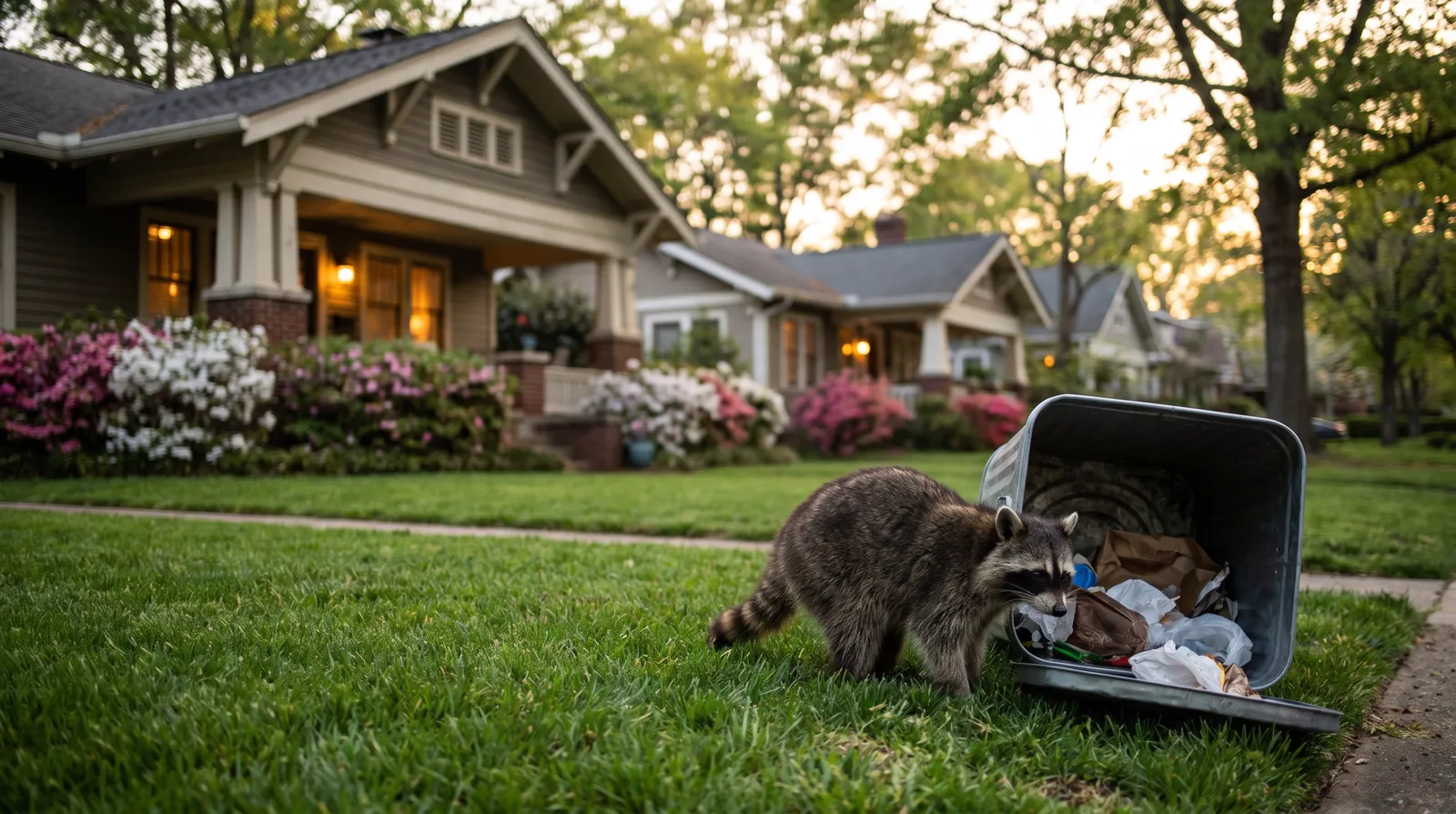
Spring Hill’s density is part of the equation. Unsecured trash cans, outdoor cat-food bowls, and bird feeders concentrate raccoons into the same backyards where pets and kids are. Removing the food removes most of the conflict.
To report a suspicious or aggressive raccoon, a stray that bit someone, or an animal acting sick:
- DOH-Hernando — 352-540-6812 (the rabies report line — suspected rabid or biting animals)
- Hernando County Animal Services — 352-796-5062 (stray pickup and aggressive-animal response)
- For ongoing wildlife questions, the Florida Fish and Wildlife Conservation Commission maintains statewide guidance at myfwc.com.
If a Person Gets Bitten or Scratched
Human exposure is the scenario worth knowing cold before it happens:
- Wash the wound immediately with soap and running water for a full 15 minutes. The CDC singles this out as the most effective first step you can take — in animal studies, thorough wound washing alone markedly lowered the chance of rabies developing.
- Go to the ER or urgent care. Post-exposure prophylaxis (PEP) — the rabies shot series given after a bite — is highly effective but must be started promptly. Don’t wait it out.
- Call DOH-Hernando so the exposure is logged and the animal, if known, can be tracked.
Rabies is essentially always fatal once symptoms appear, which is why the medical system treats a possible exposure as urgent rather than wait-and-see.
This Isn’t a One-Off — It’s a Pattern
Spring Hill is the latest in a string. In May 2025, a raccoon tested positive in the Ted Road area of Brooksville (34601). In June 2025, another confirmed-positive raccoon triggered a 60-day alert off Spring Lake Highway — that zone ran roughly Kenova Street on the north, Hayman Road on the south, Spring Lake Highway on the east, and Cobb Road on the west. Now central Spring Hill, 2026.
Three confirmed wildlife rabies events across the county in roughly a year tells you this is a standing local condition, not a freak occurrence. The raccoon population is large, the neighborhoods are close, and the virus circulates. The households that come through these alerts untouched are almost always the ones whose pets had a current rabies shot before anything happened.
If you live inside the Elgin-to-Spring-Hill-Drive box, do two things today: check your pet’s rabies record, and secure the trash and pet bowls tonight. Then save 352-540-6812 and 352-796-5062 in your phone so you’re not searching for them at 9 p.m. with a stray raccoon on the porch.