Solar Panels in Spring Hill, FL: Costs, Savings & Is It Worth It in 2026
By Hernando Beacon · July 2, 2026 · 9 min read
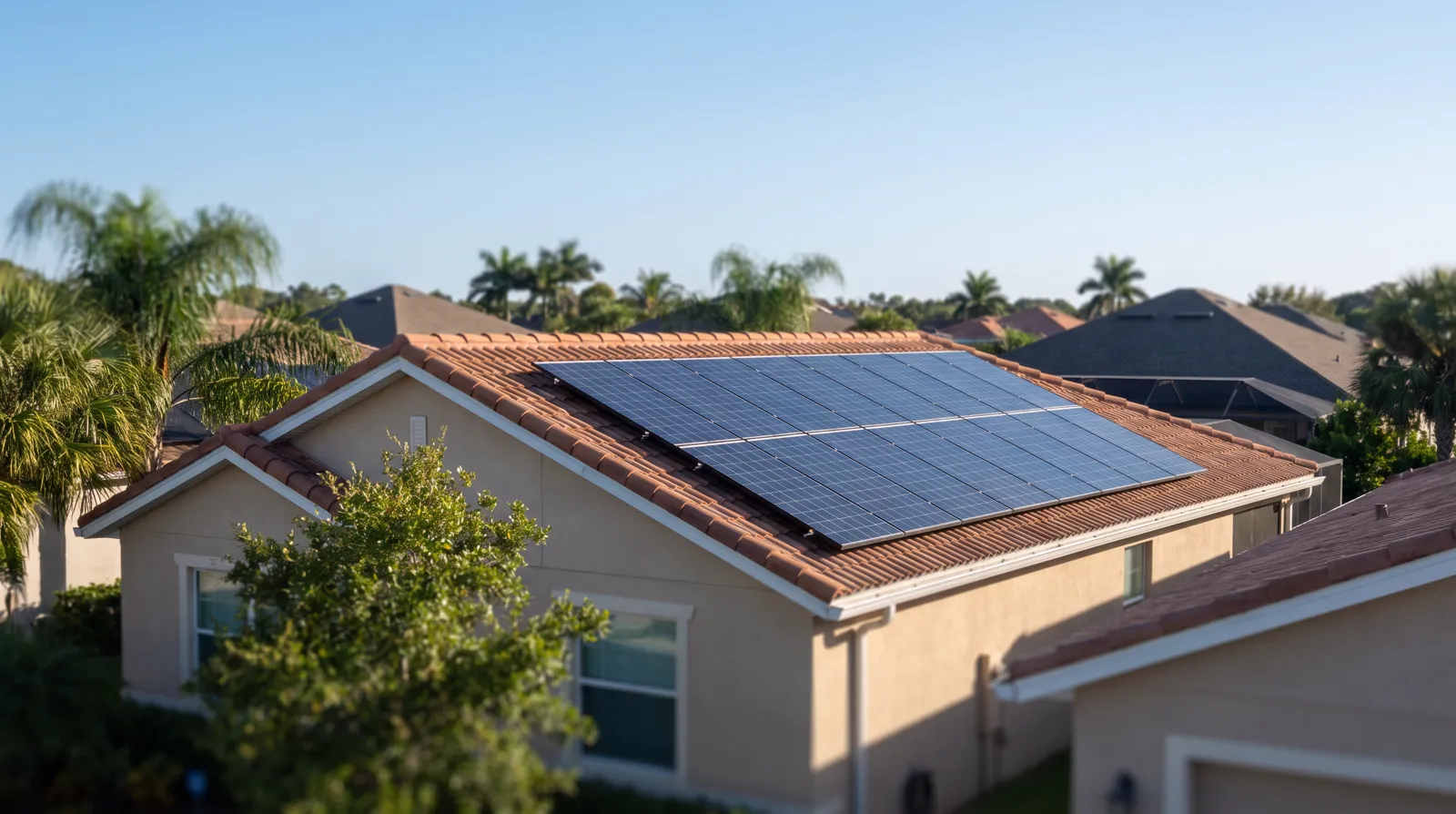
The math on solar changed for Spring Hill this year. The federal 30% tax credit that made rooftop panels an easy yes is gone for any system switched on after December 31, 2025. If you’re pricing systems in 2026, you’re paying full sticker, and whether that still pencils out depends on one thing you should check before anything else: which power company serves your address.
That utility question is the whole ballgame here, because Spring Hill is split between two of them, and they pay you back for solar in wildly different ways. Get that part right and solar can still be worth it. Get it wrong and you could spend $30,000 on a system that takes twenty years to break even. This guide walks through the real numbers, the local permit process, hurricane requirements, and the honest answer to whether you should pull the trigger this year.
First question: are you on WREC or Duke Energy?
Before you talk to a single installer, figure out who bills you for electricity. In Hernando County that’s usually one of two providers, and the difference between them is the single biggest factor in whether solar makes sense for your home.
Withlacoochee River Electric Cooperative (WREC) serves much of Hernando County, including large parts of Spring Hill. WREC is a member-owned co-op, and it does not offer full retail net metering. When your panels make more power than your house uses and you push the excess to the grid, WREC does not credit you at the rate you pay to buy power. It buys that surplus back at Seminole Electric’s avoided cost, historically closer to wholesale, roughly half of retail. Every kilowatt-hour you export is worth far less than one you consume the instant you make it.
Duke Energy Florida serves other parts of the region and offers full retail net metering. Your exported power spins the meter backward at the same rate you pay, credits roll over month to month, and any unused credit at your annual true-up is cashed out at a non-firm wholesale rate (around 2 cents per kilowatt-hour). For a solar owner, that one-to-one crediting is a meaningfully better deal.
The dollars follow the meter. On Duke, an oversized system that overproduces in spring banks full-value credits you draw down in summer. On WREC, that same overproduction is nearly given away, so the smart move is a smaller system sized tightly to what your home uses during daylight hours. Same house, same roof, two completely different right answers.
Both utilities share one rule worth knowing: systems larger than 10kW require proof of $1 million liability insurance, and on Duke, systems over 10kW carry a $240 interconnection fee. Most Spring Hill homes land under that threshold anyway.
What solar actually costs in Spring Hill in 2026
Local installed pricing runs around $2.16 per watt before any incentives. That’s the number to anchor on when a salesperson quotes you.
| System size | Rough price before incentives | Best fit |
|---|---|---|
| 5 kW | $9,192 to $12,436 | Small home, tight WREC sizing, modest bill |
| 7.5 kW | ~$16,000 | Typical 1,800 sq ft Spring Hill home |
| 10 kW | ~$21,600 | Larger home, pool pump, EV, stays under the 10kW fee line |
You’ll sometimes see much larger “average system” figures quoted around 18kW and roughly $39,000. Ignore those for a typical Spring Hill house unless you have a big roof, high summer bills, an electric vehicle, and a pool. Bigger only wins when your utility pays you fairly for the extra, which on WREC it does not.
For 2026, there is no federal credit knocking 30% off that price. What you see quoted is close to what you pay.
The savings that still exist in 2026
Losing the federal tax credit doesn’t zero out the incentives. Florida keeps two that protect your investment, and they stack with whatever net metering your utility offers.
- Property tax exemption. Adding solar raises your home’s value, but Florida exempts 100% of that added value from property tax assessment through 2037. On a $15,000 value bump, that’s roughly $250 to $400 a year you don’t pay in higher property taxes. Your appraiser can’t tax you for going solar.
- Sales tax exemption. Florida waives the 6% state sales tax on panels, inverters, batteries, EV chargers, racking, and installation labor. On a $20,000 system that’s about $1,200 off the top, applied automatically at purchase.
- Net metering / buyback. Full retail on Duke, avoided cost on WREC. This is the biggest swing and the reason your utility determines your payback.
The honest 2026 savings stack: sales tax off the purchase, property tax protection on the value, and whatever your utility credits you for exported power. Anyone still quoting a 30% federal credit for a 2026 install is working from last year’s rules.
Spring Hill’s electric rates and what solar offsets
Spring Hill homeowners pay roughly 13 cents per kilowatt-hour, about 17% below Florida’s statewide average of 16.02 cents. The typical monthly residential bill runs around $237.
That below-average rate cuts both ways. Cheaper power means the electricity you’re offsetting is worth less, which stretches out payback compared to a high-cost market. But $237 a month is still $2,844 a year, and Florida sun is abundant. A well-sized system that covers most daytime use, paired with the tax exemptions, can still deliver a solid return, especially on Duke where every exported kilowatt-hour counts at full value.
The practical takeaway: size your system to shave your actual usage, not to zero out the bill on paper. On WREC, a system that just covers your daytime consumption beats a bigger one that dumps cheap surplus onto the grid.
Permits, code, and hurricanes in Hernando County
Every rooftop system in Spring Hill needs a permit from the Hernando County Building Department, the permitting authority of record. Your installer typically pulls it for you, and it should be baked into the quote. The department doesn’t publish a fixed solar permit timeline, so call the front end directly to confirm your install date is realistic. A reputable installer will know current turnaround; a vague answer about permitting is a red flag.
On the structural side, Florida Building Code requires hurricane-rated mounting hardware on every solar install. Hernando County is inland and is not a High-Velocity Hurricane Zone (HVHZ) like Miami-Dade, so you don’t need a Miami-Dade Notice of Acceptance on your racking. You do still need wind-uplift-rated mounting engineered for our exposure. Most quality panels are rated for 130 to 160 mph winds, and properly bolted racking keeps them on the roof. Panels themselves survive hurricanes well when installed to code; the failures you hear about almost always trace back to cheap mounting or a bad roof attachment, not the glass.
Confirm two things with any installer before signing: that the racking is hurricane-rated and engineered for Hernando County wind loads, and that the roof penetrations are properly flashed and sealed. A solar array is a 25-year commitment bolted to your roof. The mounting matters as much as the panels.
Your HOA cannot say no
If you live in a Spring Hill deed-restricted community, the Florida Solar Rights Act (Florida Statute 163.04) is on your side. An HOA cannot ban solar panels outright, and it cannot force screening or placement that meaningfully cuts your system’s output. The one thing it can require is siting within 45 degrees of due south, which is where you’d want panels anyway for maximum Florida production.
In plain terms: your HOA can weigh in on aesthetics at the margins, but it can’t stop you from going solar or force you onto a shaded north-facing slope. If your board pushes back hard, that statute is the citation to bring to the meeting.
So, is it worth it in 2026?
Solar can still be worth it in Spring Hill, but the case is much stronger on some homes than others now that the federal credit is gone.
Solar likely makes sense if you:
- Are served by Duke Energy with full retail net metering
- Have high summer bills, a pool pump, or an EV adding daytime load
- Have a south-facing, unshaded roof in good condition
- Plan to stay in the home long enough to reach payback (think 10-plus years)
Be more cautious if you:
- Are on WREC and would export a lot of surplus at avoided-cost rates
- Have a modest bill and a shaded or aging roof
- Might move within a few years
- Are being pushed toward an oversized 15kW-plus system you don’t need
The move for almost every Spring Hill homeowner: confirm your utility first, get two or three itemized quotes, size the system to your real daytime usage, and make sure the tax exemptions and hurricane-rated mounting are spelled out in writing. Do that and you’ll know your actual payback before you spend a dime.
Frequently asked questions
Is solar worth it in Florida in 2026 without the tax credit?
For many Spring Hill homes, yes, but the margin is thinner. Without the 30% federal credit, your return now rests on Florida’s sales-tax and property-tax exemptions plus your utility’s net metering. On Duke Energy with full retail crediting, a right-sized system still pays off. On WREC, the payback stretches longer because exported power earns closer to wholesale, so size the system tightly to your own usage.
Does WREC or Duke Energy serve my Spring Hill house?
It depends on your exact address; Spring Hill is split between both. Check the name on your current electric bill. Withlacoochee River Electric Cooperative (WREC) covers much of the county, while Duke Energy Florida serves other pockets. Confirm this first, because it changes your solar economics more than any other factor.
How much will I actually save per month on WREC vs Duke?
The difference comes down to how each pays for your surplus. Duke credits exported power at full retail (about 13 cents per kWh here), so overproduction banks real value. WREC buys excess at Seminole Electric’s avoided cost, historically around half of retail. A homeowner who exports significant surplus sees materially better monthly savings on Duke, which is why WREC customers should avoid oversizing.
Will my HOA let me install panels?
Yes. Under the Florida Solar Rights Act, your HOA cannot prohibit solar or require screening that reduces output. It can only ask that panels sit within 45 degrees of due south, which aligns with ideal Florida placement anyway.
How long does the Hernando County permit take?
Permitting runs through the Hernando County Building Department, and your installer typically handles it. Because the county doesn’t post a fixed solar timeline, ask the department or a local installer for current turnaround before you set an install date, and treat a vague answer as a warning sign.
Do solar panels survive a hurricane?
They hold up well when installed to code. Florida Building Code requires hurricane-rated mounting hardware even in inland Hernando County, and most panels are rated for 130 to 160 mph winds. Failures almost always come from weak mounting or poor roof attachment, not the panels themselves, so confirm your racking is wind-uplift rated for our area.
What size system do I need for a typical Spring Hill house?
A typical 1,800 square foot home lands around 7.5kW, running roughly $16,000 before incentives at local pricing. Smaller homes fit 5kW; larger homes with pools or EVs may want up to 10kW to stay under the fee threshold. On WREC, lean smaller and match your daytime usage; on Duke, you have more room to size up.