Florida Drops $3M at Brooksville Airport for PHSC's New Aircraft Mechanic Program
By Hernando Beacon · June 13, 2026 · 9 min read
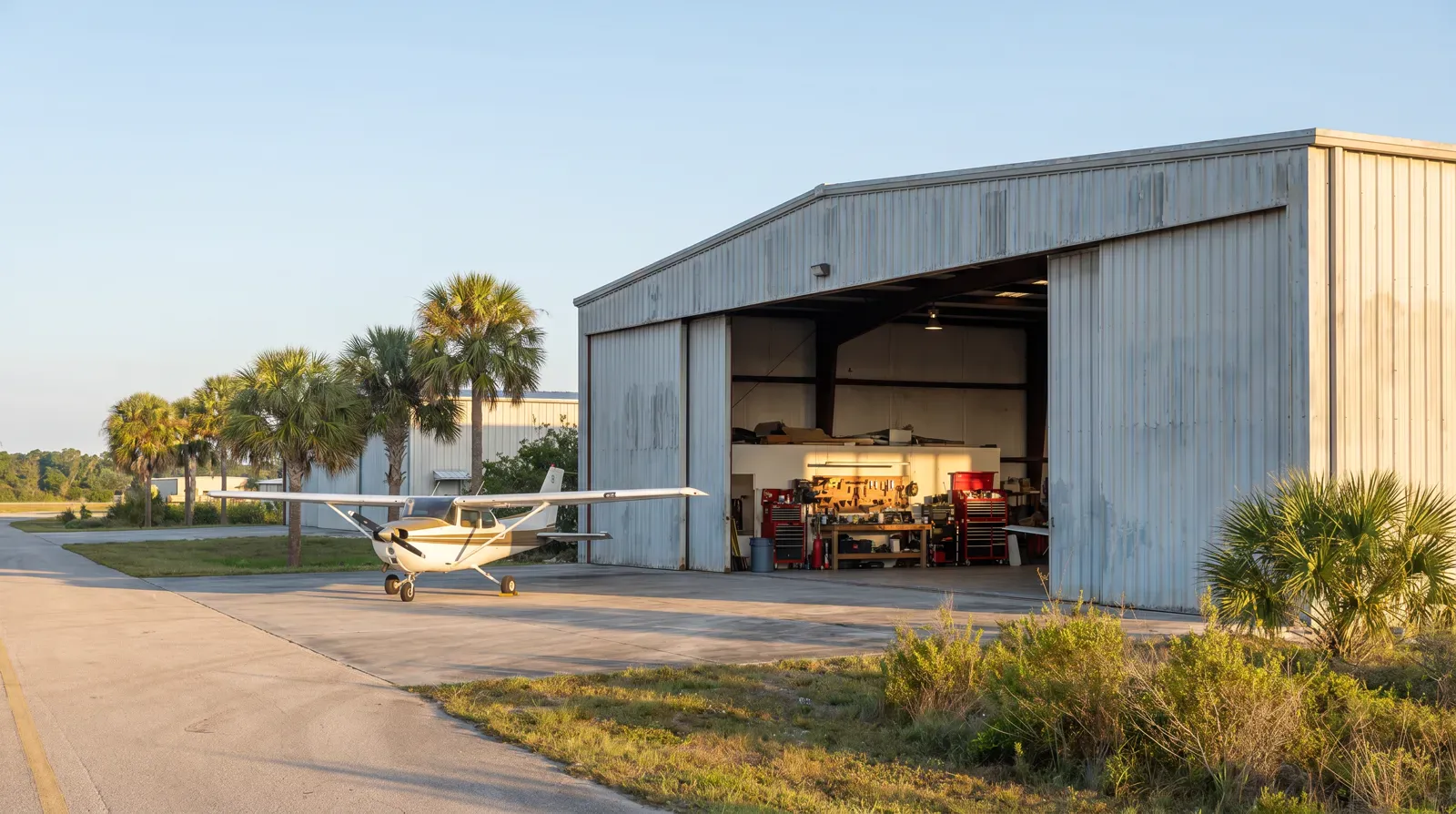
On the morning of June 10, 2026, Gov. Ron DeSantis stood at the Pasco-Hernando State College campus in Brooksville and announced a $3 million grant to launch a new airframe and powerplant program at Brooksville–Tampa Bay Regional Airport (BKV) — the everyday airport off Broad Street that most people in Hernando County drive past without thinking about. The money comes out of Florida’s Job Growth Grant Fund. The headline figure is real, but the part that actually matters for families here is what an FAA-certified A&P mechanic earns, where the program will physically operate, and who can sign up. Here is the full picture.
What was announced and where the money goes
The $3 million is one-time capital funding earmarked for one job: stand up a working airframe and powerplant (A&P) school at the Brooksville airport. PHSC President Dr. Eric Hall appeared alongside the Governor; Florida Education Commissioner Stasi Kamoutsas and Agriculture Commissioner Wilton Simpson — himself a PHSC alumnus — were also at the podium.
According to DeSantis, the funds will pay for:
- Renovation and build-out of specialized classrooms and lab space at BKV
- Purchase of real airframes and engines for hands-on student work
- Tools, test equipment, and instructional technology required by FAA mechanic-school standards
- Relocation of PHSC’s existing Professional Pilot Program from its current campus footprint to the same airport site
Quoting the Governor directly: “This money will help support the renovation and build out of specialized classrooms and labs for the new airframe and power plant program.” And on capacity: “We estimate 100 students expected to go through this program each and every year.”
That 100-students-per-year figure is the number to remember. It is the throughput the state is buying.
”Airframe and powerplant” — what that credential actually is
An A&P mechanic is the person who keeps an airplane legal to fly. The credential is federal, issued by the Federal Aviation Administration under FAA Part 65, and it has two halves: Airframe covers the structure, landing gear, hydraulics, fuel and flight-control systems; Powerplant covers engines and propellers. Most working mechanics earn both ratings and are referred to as having their “A&P.”
You cannot legally sign off on most maintenance, inspections, or repairs on a certificated U.S. aircraft without that ticket. That is what makes it durable: every airline, every charter operator, every flight school, every corporate jet, every helicopter EMS service — anywhere there is an airplane that flies for money — there is an A&P mechanic responsible for whether it leaves the ground.
There are two paths to the certificate. You either log 18 months of practical experience per rating (or 30 months for both) under a certified mechanic and then test, or you graduate from an FAA-approved mechanic school, sit the three written exams, and pass the oral and practical tests. The PHSC program is the second path — a structured route that compresses the timeline and gets students into the test seat with the lab hours already behind them.
Why Brooksville–Tampa Bay Regional Airport, specifically
BKV is the right address for a mechanic school for the same reason it has always been an interesting little airport: it has the room and the runway most general aviation traffic actually needs, and it is not boxed in by metro real estate. The airport sits on county-owned land off the U.S. 41 / Cortez Boulevard corridor with two runways, the longer one over 7,000 feet — long enough that working transports and corporate aircraft can come and go. There are existing hangars, ramp space, and a tenant base that already includes flight training and maintenance operators.
Putting an A&P school there means three things at once. Students train on real airplanes inside an actual operating airport environment, instead of a classroom hangar separated from a working flight line. PHSC’s pilot program gets co-located with the mechanic program — pilots and the people who fix the planes they fly start learning the same vocabulary on day one. And it concentrates a piece of the regional aerospace workforce pipeline in Hernando County, not Tampa or Orlando, which is the entire political and economic argument the Governor was making at the podium.
The airport, formerly known as Hernando County Airport, took its current name in 2013 after a mediated agreement with the Hillsborough County Aviation Authority. The “Tampa Bay” in the name is geography and marketing; the FAA identifier is BKV.
How this fits PHSC’s existing footprint
This is not PHSC’s first move into aviation, and that matters for how fast the new program can realistically come online. The college already operates a Professional Pilot Program and Unmanned Vehicle (drone) programs, with the pilot program now being moved to the airport site under this grant.
PHSC has also been building out workforce funding for several years running. The college has previously been awarded $1.63 million for semiconductor career and technical education, $227,943 through the Florida Pathways to Career Opportunities apprenticeship program, and more than $600,000 in Open Door Grant funding that pays for short-term workforce training in shortage occupations. The $3 million A&P grant is the largest single capital award of that recent stretch and is the one that puts a new physical school in the county.
What the job actually pays
This is where the rubber meets the runway for a Hernando County family weighing whether their kid — or themselves — should sign up. The pay picture has two layers and both are honest.
In Florida specifically, the going rate for an airframe and powerplant mechanic in 2026 averages roughly $50,000 a year, or about $24 an hour, with experienced mechanics in the 75th percentile clearing roughly $56,000 and the top tier of mechanics in the state hitting around $65,000. That is the entry-and-mid-career range you can plan around if you stay in Florida and work general aviation, regional MROs, or corporate flight departments out of fields like BKV, Tampa, St. Petersburg, or Orlando.
The country-wide picture is meaningfully higher. The U.S. Bureau of Labor Statistics put the median annual wage for aircraft mechanics and service technicians at $78,680 in May 2024 — the most recent confirmed federal figure — with the top end well into six figures at major airlines and heavy MROs. The honest read: Florida pays below the U.S. median, and a graduate willing to chase airline or heavy-maintenance work in markets like Atlanta, Dallas, or Memphis will typically out-earn one who stays local. A graduate who stays local trades some peak earnings for a short commute and Florida cost of living. Either trade is reasonable; the credential travels.
A useful way to compare the choices Hernando County families are actually weighing:
| Path | Time to working credential | Florida entry pay (2026, avg) | Working location |
|---|---|---|---|
| PHSC A&P program (FAA-approved school) | ~18–24 months | ~$45–55K, rises with experience | Airport, hangar, ramp — physical work |
| 4-year college (in-state) | 4 years | Highly variable by major | Office-based for most majors |
| CDL (PHSC offers via workforce ed) | Weeks to months | ~$50–60K to start | On the road |
| Welding / HVAC trade | 6–18 months | ~$40–55K to start | Job sites, residential, commercial |
The case for the A&P credential, in plain terms, is that it is federal, portable to every state, recession-resistant because airplanes always need maintenance, and built for people who would rather work with their hands on something that matters than spend four years in a lecture hall.
What the state is buying with $3 million
Step back from the photo op for a second and look at what the math actually says. The Job Growth Grant Fund, in DeSantis’s framing on June 10, has now pushed about $12 billion into Florida workforce education since he took office in 2019. The state has tripled down on career and technical education at both the high-school and college level: roughly 818,000 K-12 CTE participants and 512,000 postsecondary CTE students statewide as of the announcement.
The political message at the podium was that Florida is not relying solely on four-year universities to produce its workforce. The Governor’s exact framing: “We want to provide opportunities for students to choose their own way. It doesn’t have to be four-year brick and ivy universities.”
Whether that overall strategy works at the state level is a debate for somewhere else. For Hernando County, the practical effect of this specific grant is narrower and more concrete: a new FAA-approved mechanic school will operate inside an airport we already have, training roughly 100 students a year for a credential that pays a real living and is in demand from every operator that owns an airplane.
Frequently asked questions
When can students actually enroll?
PHSC has not posted a published start date for the new airframe and powerplant program. The grant pays for build-out and equipment first — labs, airframes, tools — which has to be in place before the FAA will certify the school under Part 147 standards. Realistic expectation: first cohort sometime in the 2027 academic year, pending PHSC’s official announcement. Keep an eye on the PHSC website for the formal start date.
Will I qualify for financial aid?
PHSC participates in standard federal and state financial aid (FAFSA, Florida Bright Futures where applicable). The college also administers the state’s Open Door Grant, which specifically funds short-term workforce training in shortage occupations and has covered aviation maintenance at other Florida colleges. Eligibility for Open Door funding for the A&P program will depend on how PHSC structures the program length and credential — confirm directly with PHSC financial aid once enrollment opens.
Do I need a pilot’s license to enroll?
No. A&P is a mechanic credential, not a pilot credential. You do not need to know how to fly to fix an airplane. PHSC’s Professional Pilot Program — moving to the same airport site under this grant — is a separate track for students who want to fly.
Is the program guaranteed to be FAA-approved?
The $3 million grant is for the build-out; FAA approval of the school itself is a separate process under Part 147 of the Federal Aviation Regulations. PHSC will have to submit curriculum, facilities, instructor qualifications, and equipment for FAA review and certification. The grant funds the prerequisite — the FAA sign-off is the gate the college still has to walk through before the first student earns a certificate.
Are airlines, MROs, or local operators partnered with the program?
No specific employer partners were named at the June 10 press conference. Florida’s aerospace employer base includes major MROs and corporate flight departments around the Tampa Bay, Orlando, and Jacksonville metros, plus general aviation operators based at BKV itself. Industry advisory boards typically attach to FAA-approved A&P schools during the Part 147 application process; PHSC has not yet announced any.
Where does the $3 million sit inside Florida’s larger Hernando County investment?
The $3 million A&P grant is separate from previous state workforce investments in Hernando County. The most directly comparable prior award was a 2021 $6.1 million Job Growth Grant Fund award supporting an 18-acre dual-campus workforce site shared between PHSC and Suncoast Technical Education Center. That earlier project covered manufacturing, professional services, aviation, and medical lab training in broad terms. The June 10 grant is more surgical: one program, one airport, one credential.
What if I want to start training right now?
You can begin the underlying coursework — math, physics, basic aviation theory — through PHSC’s existing programs now, or pursue the 18-month-per-rating practical-experience path under a working FAA-certified mechanic at BKV or another regional field. That path requires logged supervised experience and is harder to navigate without an employer willing to bring you on. The PHSC school route is generally the cleaner path for someone starting from zero.
For Hernando County, the takeaway is simple. A real, federally-credentialed trade school is coming to the airport we already own, paid for with money already authorized, training people for jobs that already exist at fields throughout Florida. The details that still matter — enrollment dates, tuition, employer partners, FAA certification timing — are PHSC’s to publish next. We will update this page as soon as the college does.